Lance Corporal William George Smith
8th Battalion Devonshire Regiment, 10037
Killed in Action
Date of Birth: 18 October 1894
Place of Birth: Newton Blossomville, Buckinghamshire
Date of Death: 25 September 1915 aged 21
Buried: Remembered on Loos Memorial, France; Seafront Memorial and St. James’ Church Memorial Window, Teignmouth.
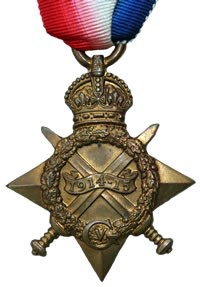
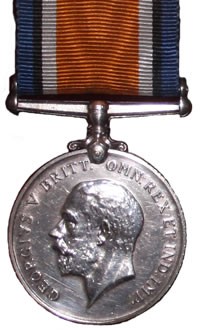
Awarded the 1914-15 Star, The British War Medal and the Victory Medal

Lance Corporal William George Smith, age 21.
William was born on 18 October 1894 and baptised on 25 December at Newton Blossomville, Buckinghamshire, the son of Harry and Louisa Smith. The 1901 census showed him with his parents and siblings in Hinton Waldrist, Faringdon. He attended the local school at Hinton from 1901 to 1907.
On the 1911 census he was still living with parents in Hinton Waldrist and working as an ironmonger’s apprentice.
Military records show William enlisted in Exeter immediately war broke out with the 8th Battalion Devonshire Regiment, army service number 10037.
Believed to be a friend of the Avent family of Teignmouth. William landed in France with his regiment on 25 July 1915 and was killed in action during the Battle of Loos on 25 September 1915.
Remembered on Loos Memorial, France; Seafront Memorial and St. James’ Church Memorial Window, Teignmouth. Military records show that his father, Harry, received a war gratuity of £7.2s.4d. paid on 5 June 1919.
The 8th and 9th Battalions of the Devonshire Regiment
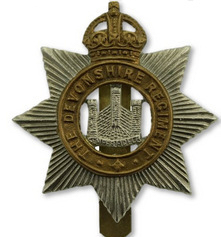 Devonshire Regiment
cap badge
The 8th and 9th Battalions of the Devonshire Regiment were formed in 1914 from war-time volunteers.
After very little training they landed at Le Havre in France on the 28th July, 1915 and moved to the Front in August 1915.
Le Havre is a port in France which during the First World War was used as a base for storage and as a transport hub . 1.9 million British soldiers passed through Le Havre en route to the Western Front which was further North.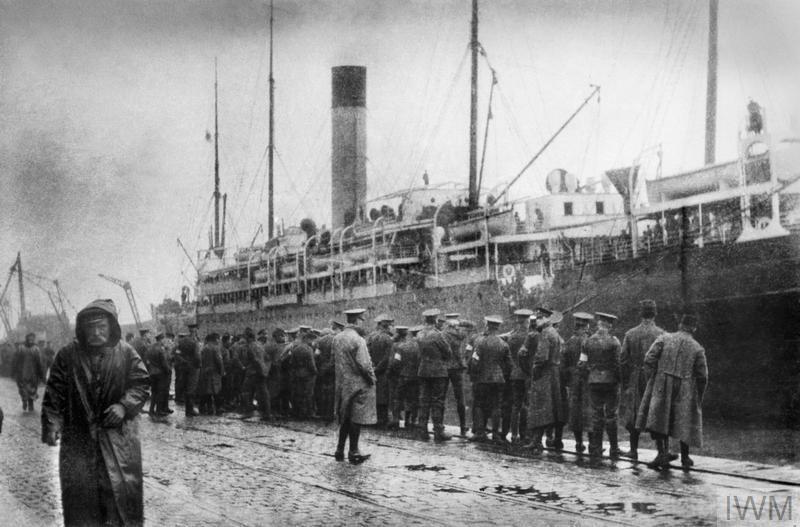 British soldiers arrive in Le Havre, France. © IWM (Q 51472)
The men had only a very brief experience of trench warfare when on the 25th September 1915, the British Army launched a massed attack against the German defences, this was later to be known as the Battle of Loos.
At the Battle of Loos both sides used poison gas as a weapon.
 Men preparing for a gas attack © IWM (Q 51650)
This was the first time that the British used poison gas.
After they released the gas the wind changed and a green blanket of gas, dust and smoke as high as a two-storey house covered some of the British troops, it was very difficult to see anything, some men had terrible difficulty breathing and others died later because of the damaging effects of the gas.
'The gas hung in a thick pall over everything, and it was impossible to see more than ten yards. In vain I looked for my landmarks in the German line, to guide me to the right spot, but I could not see through the gas.'
Account by George Wilfred Smith, 2nd The Leicestershire Regiment, to his fiancée.
Before the men left the safety of their trenches and went 'over the top' to capture the enemy positions the Gunners would often fire a huge artillery barrage to shatter the enemy's barbed wire and other defences and kill defending troops.
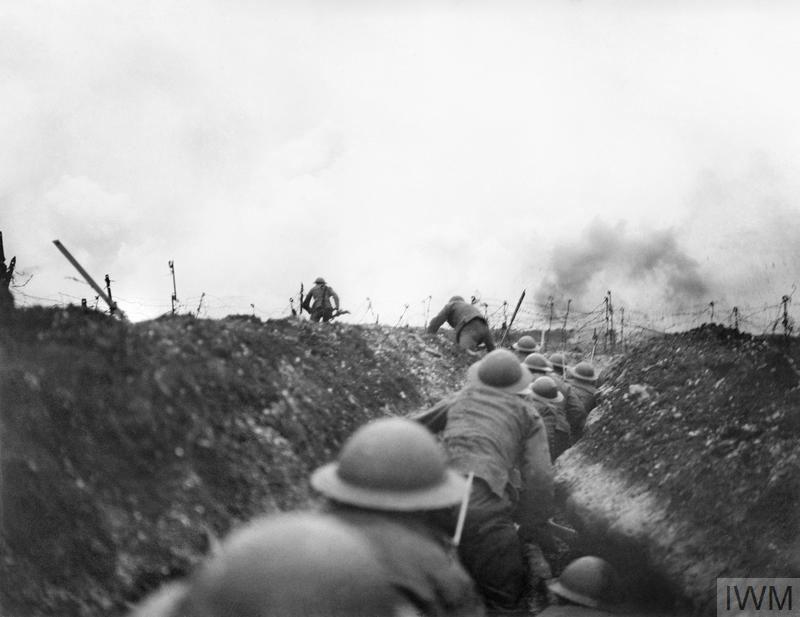 Soldiers leaving a sap trench © IWM (Q 5100)
 German barbed wire entanglement © IWM (Q 4593)
In this battle the artillery barrage had not cleared all the barbed wire, so the Devons had to cut their way through whilst the Germans fired machine-guns at them.
The 8th and 9th Devons were battalions with 1000 men in each unit. In a single day they had more than 1000 casualities and 500 men died or went missing.
In the First World War six million men went missing and were never found, their bodies were lost in the mud. Sometimes bodies would be found as new trenches were dug.
The land had been heavily wooded before the war began.
 British dead in front of a captured German trench; near Loos, 30th September, 1915 © IWM (Q 28980)
Casualties at the Battle of Loos on the 25th September 1915 were the worst in a single day for the British army, with some 8,500 dead.
The Battle of Loos lasted from 25th September to 15th October, 1915.
William George Smith died on the first day of the Battle of Loos aged 21, he is remembered in Teignmouth.