Acting Corporal Thomas Edward Simon
9th Battalion, Devonshire Regiment, 3/7181
Died in Military Service
Date of Birth: 1881
Place of Birth: St. Anne's, Alderney, Channel Islands
Date of Death: 14 November 1915 aged 39
Buried: Bethune Town Cemetery, France
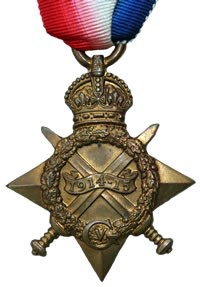
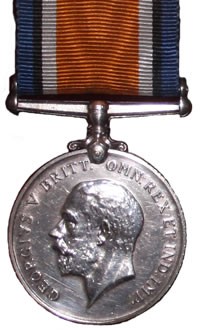
Awarded the 1914-15 Star, The British War Medal and the Victory Medal

Acting Corporal Thomas Edward Simon, age 39. Born in 1881, son of Thomas, a farmer, of St. Anne's, Alderney, Channel Islands.
He was shown on 1881 census with his father a widower and siblings including his brother John living in Alderney. The 1891 census appears to show him in Carmarthenshire. He was shown on 1901 as born in Jersey and living at Bishops Teignton (Bishopsteignton) and on 1911 census as born in Kenton and working in Chudleigh.
There are several families with the surname of Simon who come from Alderney, Channel Islands, however through tracing his brother, John Henry Simon, who is named as his sole legatee it is possible to verify that this is the correct soldier. (John's wife, Gertrude, was from Starcross and they were married at Starcross; his father was Thomas Simon a farmer from Alderney.
He was shown on the electoral roll in 1920 at 23 Bitton Road (as mentioned on Thomas' military record).
Thomas's army records state that he was the brother of Mr J H Simons, 26 Bitton Avenue, Teignmouth.
Thomas served in the 9th Battalion, Devonshire Regiment, army service number 3/7181. His military record shows that he died of heart failure on 14 November 1915. Buried in Bethune Town Cemetery, France.
The 8th and 9th Battalions of the Devonshire Regiment
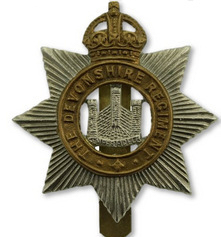 Devonshire Regiment
cap badge
The 8th and 9th Battalions of the Devonshire Regiment were formed in 1914 from war-time volunteers.
After very little training they landed at Le Havre in France on the 28th July, 1915 and moved to the Front in August 1915.
Le Havre is a port in France which during the First World War was used as a base for storage and as a transport hub . 1.9 million British soldiers passed through Le Havre en route to the Western Front which was further North.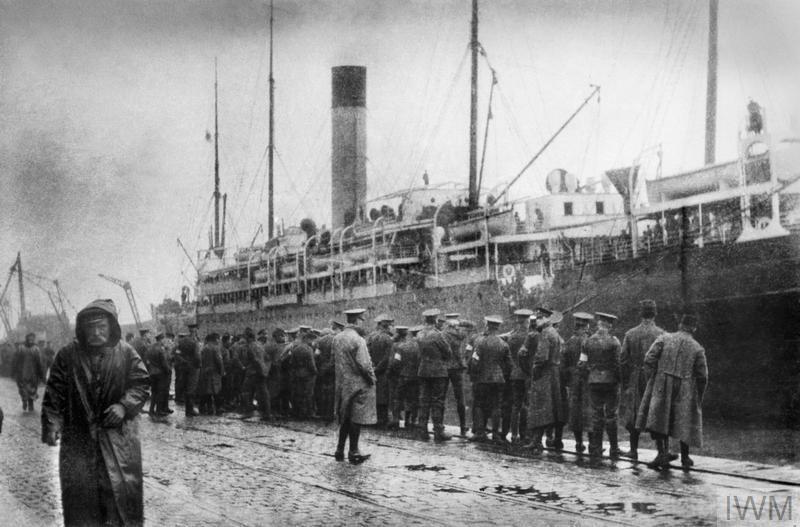 British soldiers arrive in Le Havre, France. © IWM (Q 51472)
The men had only a very brief experience of trench warfare when on the 25th September 1915, the British Army launched a massed attack against the German defences, this was later to be known as the Battle of Loos.
At the Battle of Loos both sides used poison gas as a weapon.
 Men preparing for a gas attack © IWM (Q 51650)
This was the first time that the British used poison gas.
After they released the gas the wind changed and a green blanket of gas, dust and smoke as high as a two-storey house covered some of the British troops, it was very difficult to see anything, some men had terrible difficulty breathing and others died later because of the damaging effects of the gas.
'The gas hung in a thick pall over everything, and it was impossible to see more than ten yards. In vain I looked for my landmarks in the German line, to guide me to the right spot, but I could not see through the gas.'
Account by George Wilfred Smith, 2nd The Leicestershire Regiment, to his fiancée.
Before the men left the safety of their trenches and went 'over the top' to capture the enemy positions the Gunners would often fire a huge artillery barrage to shatter the enemy's barbed wire and other defences and kill defending troops.
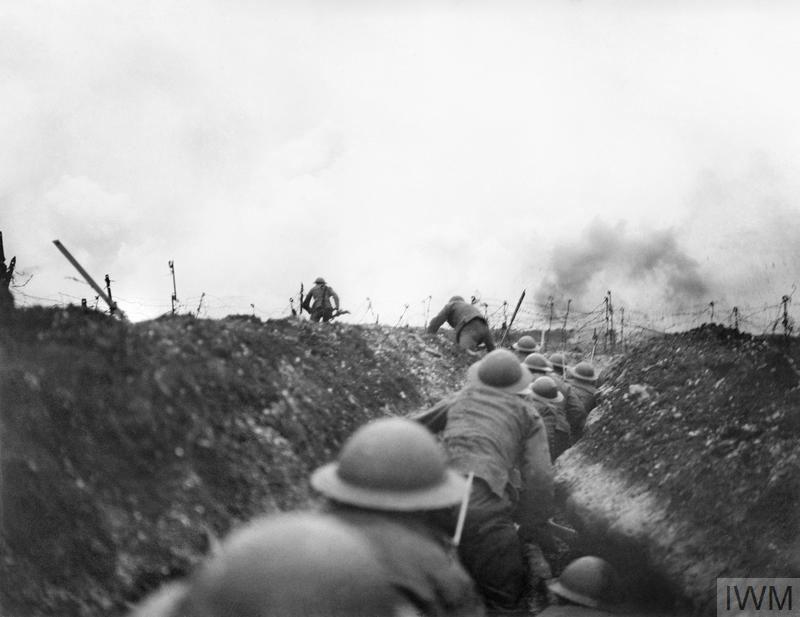 Soldiers leaving a sap trench © IWM (Q 5100)
 German barbed wire entanglement © IWM (Q 4593)
In this battle the artillery barrage had not cleared all the barbed wire, so the Devons had to cut their way through whilst the Germans fired machine-guns at them.
The 8th and 9th Devons were battalions with 1000 men in each unit. In a single day they had more than 1000 casualities and 500 men died or went missing.
In the First World War six million men went missing and were never found, their bodies were lost in the mud. Sometimes bodies would be found as new trenches were dug.
The land had been heavily wooded before the war began.
 British dead in front of a captured German trench; near Loos, 30th September, 1915 © IWM (Q 28980)
Casualties at the Battle of Loos on the 25th September 1915 were the worst in a single day for the British army, with some 8,500 dead.
The Battle of Loos lasted from 25th September to 15th October, 1915.
Thomas Edward Simon died of heart failure a month later on the 14 November 1915 aged 39. What was left of the 9th Battalion was at Givenchy.