Petty Officer (2nd Class) John Henry O’Brien
HMS Goliath, Royal Navy
Killed in Action
Date of Birth: Quarter 1, 1874
Place of Birth: Bloomsbury, London
Date of Death: 13 May 1915
Buried: Remembered on Portsmouth Naval Memorial; Seafront Memorial and St. Michael’s Church Memorial, Teignmouth, Devon
Petty Officer (2nd Class) John Henry O’Brien age 41.
Born in Quarter 1, 1874 registered in Bloomsbury, son of John, bricklayer, and Mary O’Brien. On 1881 census the family were shown living in St. Pancras, London. By 1901 he was shown on board ship as a P.O. 2nd class, Royal Navy.
The 1911 census showed him living with his wife and children at 4 Coast Guard Station, Teignmouth, where he was a boatman/coastguard.
He married Frances Elizabeth Beeby in 1896 registered at Pancras in Quarter 1.
John was serving with the Royal Navy, service number 156190, on board HMS Goliath when he was killed in action as the ship was torpedoed off the Gallipoli peninsula on 13 May 1915.
Remembered on Portsmouth Naval Memorial; Seafront Memorial and St. Michael’s Church Memorial, Teignmouth.
His eldest son Private John William O'Brien was killed on 25 March 1918.
HMS Goliath
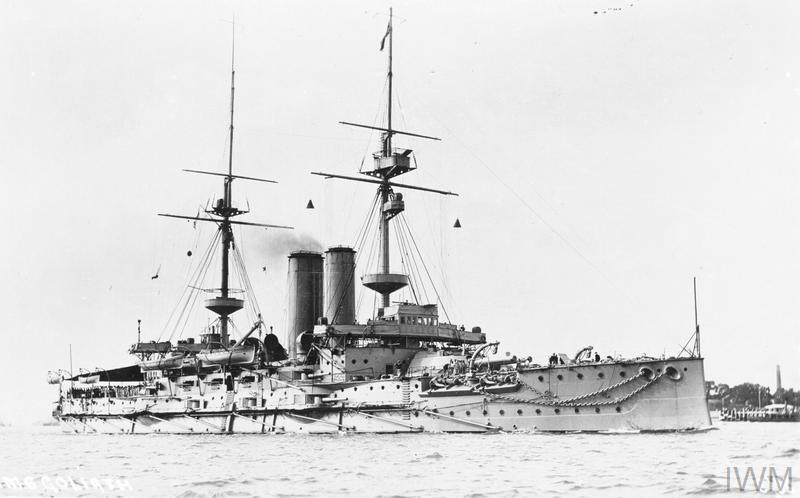 Battleship HMS Goliath. © IWM (Q 75259)
HMS Goliath was a battleship built for the Royal Navy in the late 1890's.
By the start of the First World War, she was 17 years old and already considered outdated as warship design had developed so quickly, she was outmatched by the vessels that she had to fight.
HMS Goliath started the war escorting troopships, and later supported the Gallipoli landings.
On the night of 12-13 May, a German officer serving with the Turkish fleet, took the destroyer Muavenet-I-Miliet through the Dardanelles straits to attack the Allied battleships.
It was foggy and the destroyer got within torpedo range of the Goliath before being spotted and launched three torpedoes. All hit their target.
The old Goliath was struck by 3 torpedoes in quick succession on wednesday morning at 1.28am. I was awoken by the explosions. The ship heeled at once to an angle of 5 degrees to starboard. There was no panic as it was all too sudden for anyone to realise what had happened.
I went up to the quarterdeck in my pyjamas.The ship was heeling over fast. When the starboard side was level with the sea, she stopped for about 30 seconds. Then she heeled rapidly up again. I dived from the port side. I struck the side of the ship with my face. It was horrid feeling my nose slithering over the wet side. I suppose I dived about 30 feet as I saw a good many constellatons when I struck the water.
I swam about 200 yds away and turned around to see her sink. She had heeled back to almost an even keel and was going down bows first with her stem about 40' up in the air. You could plainly hear all the crockery and furniture tumbling about and breaking up inside her. Then she heeled completely over until her bottom was uppermost in the air and slid right under. You could hear the cries of drowning men all around.
Extract from a letter that a survivor, Midshipman Weld-Forester wrote to his mother.
Imperial War Museum Book of the War at Sea 1914-18 By Julian Thompson
The Goliath sank quickly and about 570 of the 750 crew drowned.
That was the night that John Henry O’Brien of Teignmouth died.