Sergeant George Webber
2nd Battalion, Devonshire Regiment
Killed in Action
Date of Birth: 1884
Place of Birth: Teignmouth, Devon
Date of Death: 17 June 1916 aged 32
Buried: Aveluy Communal Cemetery, Somme. Remembered on Seafront Memorial and St James' Church Memorial Window, Teignmouth, Devon.
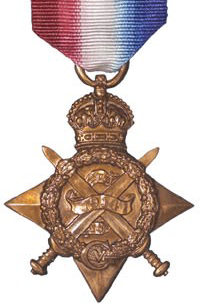
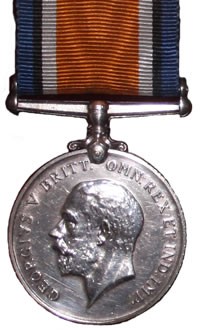
Awarded the 1914 Star, the British War Medal and the Victory Medal

Sergeant George Webber age 32.
Born in Teignmouth in 1884, he was the eldest son of William Webber who was born at Hennock and Eliza born in Kingsteignton. In 1891 the family were living at 30 Coombe Road, Teignmouth, and again in 1901 when George was working as an ironmonger's errand boy.
The family are still at this address in 1901, George is recorded at St. George's Barracks, Malta, where he was serving with the army as Lance/Corporal.
He enlisted with the Devonshire Regiment, service number 7310, in 1903 and was posted to 2nd Battalion, Devonshire Regiment.
In these pre-war years the 2nd Devon’s served in UK, Malta and Crete; in 1912 they were posted to Egypt and it was here that Lance/Sergeant Webber was serving at the outbreak of the First World War; he arrived in France with his regiment on 6 November 1914.
The Teignmouth Post reported that he had been serving at the front for 29 months.
All three of his brothers were serving in the war, and his mother was paid his war gratuity. George was killed in action on 17 June 1916.
Buried at Aveluy Communal Cemetery, Somme. Remembered on Seafront Memorial and St James' Church Memorial Window, Teignmouth, Devon.
The 2nd Battalion of the The Devonshire Regiment
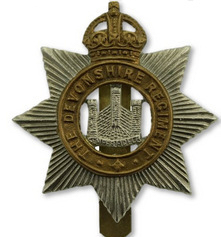 Devonshire Regiment
cap badge
In August 1914 his battalion were in Cairo, Egypt to protect the Suez Canal.
On the 1 October 1914 they returned to England where reservists added to their numbers.
They landed at Le Havre, France on 6 November 1914 as part of the 23rd Brigade in the 8th Division.
The 2nd Devons then marched to the Front.
 By Earnest Brookes. National Library of Scotland License: CC BY 4.0
By mid-November 1914 they were at Messines where they served in the trenches near Neuve Chapelle.
They had 20 casualties and lost another 70 men to sickness (mostly frostbite).
“Four inches of snow on the ground and snowing up to the 22nd (November) it was nearly impossible to sleep with only one blanket.
Barn we occupied last week blown up by shell fire. Had over nine hundred sick and wounded in a week.
The men having come straight from India &c (Cairo, Eygpt) went right into the trenches, owing to the shortage of troops, the snow and intense cold was playing havoc with them, and the bulk of the frost bite cases were quite helpless with swollen feet and had to be evacuated”.
War Diary of Albert House
Sergeant-Major of the 24th Field Ambulance
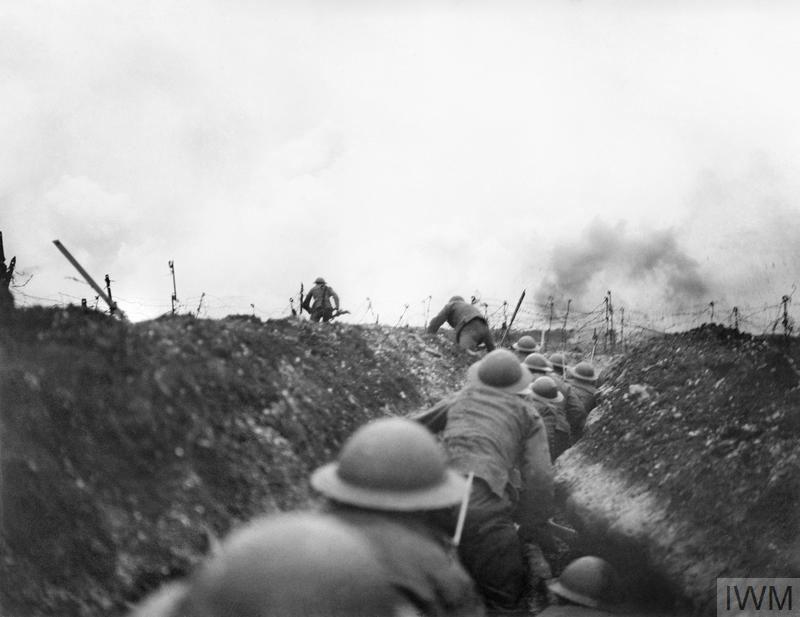 Soldiers leaving a sap trench © IWM (Q 5100)
In December 1914 the 2nd Devons lost 128 men in capturing a German position known as the Moated Grange.
They remained in this area until March 1915, when they lost heavily when they attacked the German lines at Neuve Chapelle on the 10th March.
In April 1916, the 2nd Devons went to the Somme to ready for the offensive. 150,000 fighting men were to be deployed along a front of 12 miles. By late June 1916, the area swarmed with troops.
 Shelling near the British trenches, Western Front, during World War I. This photograph must have been taken by one of the official war photographers as it appears to have been shot from inside a frontline trench. National Library of Scotland License: CC BY 4.0
The nearby village of Hénencourt was behind the British lines in 1916 and was a rest area for troops going to and from the trenches. The woods surrounding it contained a large army camp.
The 2nd Devons were alternating a few days in Hénencourt camp with a few days in the Albert-Bouzincourt trenches, when on the 17th June 1916 Sergeant George Webber of Teignmouth was killed.
On that day the Devons' trenches were being shelled in the daylight and under machine-gun fire throughout the night.
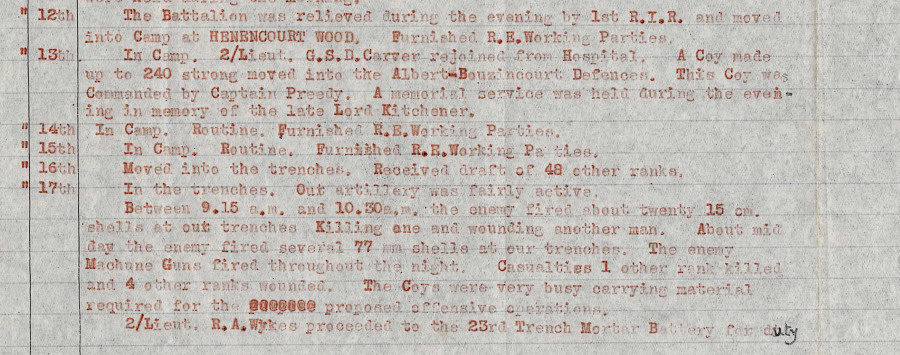 2nd Battalion Devonshire Regiment war diary extract, June 17 1916