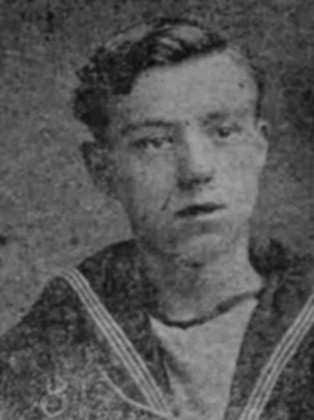
Stoker 1st Class Frederick Meyers
HMS Indefatigable, Royal Navy
Killed in Action
Date of Birth: 1893
Place of Birth: Teignmouth, Devon
Date of Death: 31 May 1916 at the Battle of Jutland, aged 23
Stoker 1st Class Frederick Meyers age 23.
Frederick was born in 1893, the son of Henry and Grace (née Oats); the family lived at 39 Willow Street Teignmouth. He was shown on the 1901 census with his family at this address. The 1911 census showed him on board a Royal Naval Vessel, he was a stoker 2nd class.
Frederick joined the Royal Navy on the 9 September 1909 his service number was K. 4224 (Dev), he gave the wrong date of birth as he was under age; he served as a Stoker 2nd class, promoted to 1st class in 1911.
He was posted to HMS Indefatigable on 15 March 1915 and was on board when it was sunk on the 31 May 1916 at the Battle of Jutland. The Teignmouth Post reported that he died on his 23rd birthday.
His younger brother Edward Meyers died with him.
 Newspaper clipping
Remembered on Plymouth Naval Memorial; Seafront Memorial and St James’s Church Memorial Window, Teignmouth.
Edward and Frederick were not the only pair of brothers lost on HMS Indefatigable that day as five other pairs of brothers who were Stokers also died.
HMS Indefatigable
The battle-cruiser HMS Indefatigable was at the Battle of Jutland.
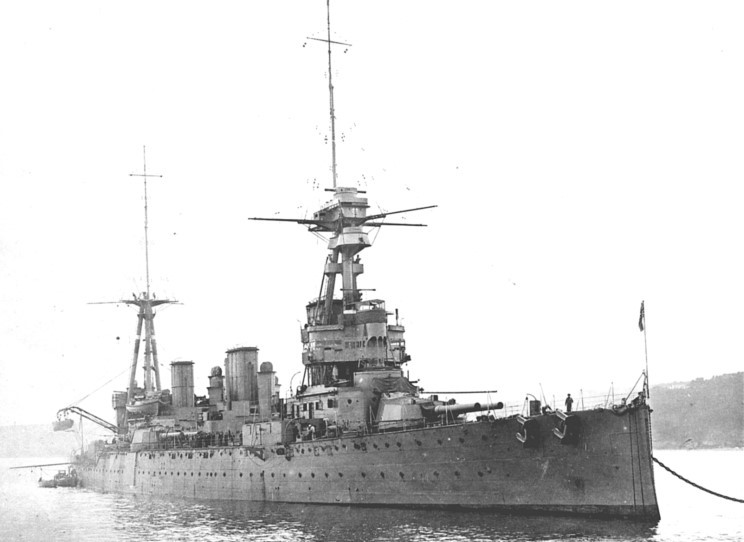 HMS Indefatigable - Courtesy of Michael W. Pocock and www.MaritimeQuest.com
She was repeatedly hit by 11-inch shells from the German battle-cruiser 'Von der Tann'.
The ammunition storage area exploded and she sank very quickly.
All but 4 of her crew of 1,017 were killed.
 HMS Indefatigable Blowing Up.The fighting at Jutland; the personal experiences of forty-five officers and men of the British Fleet by Fawcett, Harold William; Hooper, Geoffrey William Winsmore
The message came up for someone to go aloft to clear the flags. I went up, took my sea boots off first, climbed out the foretop, went up the 'Jacob's' ladder' right to the very top. I unfurled the flag and I sat on the wireless yard looking around, naturally watching the firing.
There was a terrific explosion aboard the ship - the magazines went. I saw the guns go up in the air just like matchsticks - 12" guns they were - bodies and everything. She was beginning to settle down. Within half a minute the ship turned right over and she was gone.
I was 180 feet up and I was thrown well clear of the ship, otherwise I would have been sucked under. I was practically unconscious, turning over really. At last I came up on top of the water.
Written by Signaller C. Falmer
HMS Indefatigable.
The Battle of Jutland
This was the largest naval battle of the First World War (May 31 - June 1, 1916).
It involved involved 250 Warships and around 100,000 men.
The German and British navies were 10 miles apart and pounded each other with shells for a whole day.
The German High Seas Fleet had hoped to ambush and destroy the British Grand Fleet in the North Sea.
The British were warned by their codebreakers and put two forces to sea early, they lost 14 ships and over 6,000 men in the battle but the fleet was still ready to fight the next day.
Amongst those losses were six men from Teignmouth. Two brothers, Edward and Frederick Meyers, were both stokers aboard HMS Indefatigable; it was Frederick's 23rd birthday. Frank Morrish had just returned from leave, he was chief armourer on HMS Defence. Arthur Kidston and William Mutters were both serving in the Royal Marine Light Infantry; Arthur was on board HMS Black Prince and William on HMS Queen Mary. Seaman Stephen Sienesi died of wounds on board HMS Petard and was buried in Edinburgh.

The Battle ended in a stalemate, both sides claimed victory.
The German navy did not seriously challenge British control of the North Sea during the First World War again after that battle, as a result the British were able to blockade essential supplies from reaching Germany which contributed to Germany losing the war.
Warships of the Grand Fleet in the North Sea. © IWM (Q 68706)