Private William James Coombes
2nd Battalion, 24th (1st Wessex) Field Ambulance, Royal Army Medical Corps (RAMC)
Killed in Action
Date of Birth: 1893
Place of Birth: Teignmouth, Devon
Date of Death: 14th August 1916
Buried: Chaplain, France. Remembered on Thiepval Memorial, Somme; Seafront Memorial and St. Michael’s Church Memorial, Teignmouth and the RAMC Memorial at Exeter Cathedral, Devon
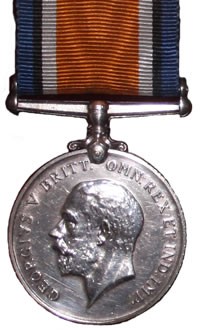

Awarded the British War Medal and the Victory medal
Private William James Coombes age 23. William, an only child, was born 1892 in East Teignmouth and baptised at St. Michael’s Church on 24 February 1892, his parents were William Henry and Ellen Maria Coombes, his father was a coach builder.
In 1901 he was living with his family at Myrtle Hill and by 1911 the family had moved to 11 Hollands Road, Teignmouth where he was working in his father's business; he was a keen member of the swimming club.
As a member of the Territorials, when war broke out he enlisted at Exeter in the Royal Army Medical Corps, service no. 1798.
William was serving with 2nd Battalion, 1st Wessex Field Ambulance, when he was killed in action on 14 August 1916 in the same incident as S Parker. Remembered on Thiepval Memorial, Somme; Seafront Memorial and St. Michael’s Church Memorial, Teignmouth. A gratuity was paid to his father.
"This morning, Mr. W. Coombes of Hollands Road, received a letter from the Lieutenant Colonel commanding, informing him of the death, at the front, of his only son and child, Private William Coombes of the Royal Army Medical Corps.
In his letter to Mr. Coombes, the officer commanding says that Private Coombes was at the advanced dug-out dressing station, attending to the wounded, when a German shell hit the dug-out and exploded in the middle of it, killing and wounding about a dozen men.
A party of his comrades dug out his remains which were buried by the Chaplain in a trench not far from the spot where he was killed.
Private Coombes was in the employ of his father, a coach builder, and was a well-known member of the Swimming Club."
Teignmouth Post, Friday 25th 1916

Private Samuel Parker was killed in the same incident which killed Private William Coombes, also in the RAMC, from Teignmouth.
Remembered on Thiepval Memorial, Somme; Seafront Memorial and St. Michael’s Church Memorial, Teignmouth and the RAMC Memorial at Exeter Cathedral.
A Royal Army Medical Corps Field Ambulance
A Field Ambulance was not a single vehicle, but an entire mobile hospital that served in the combat zone.
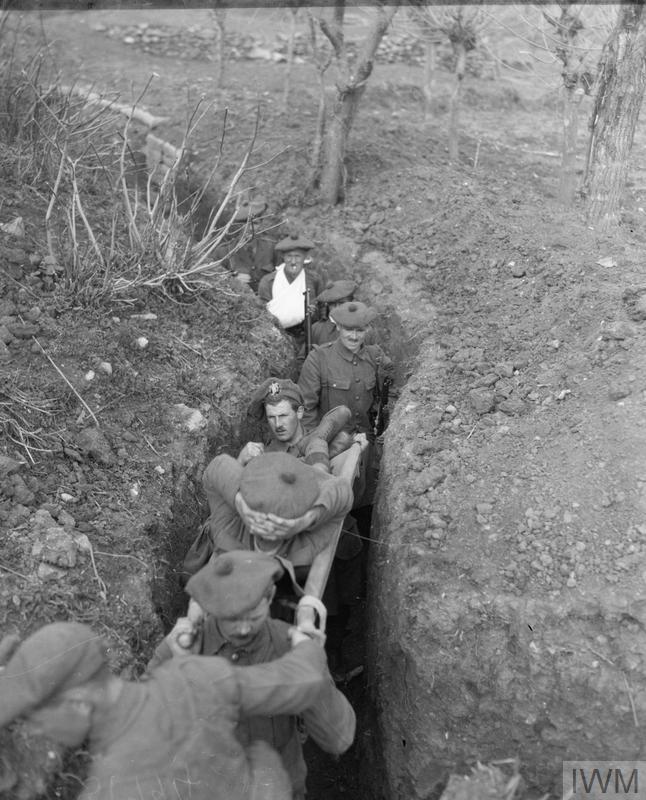 Casualties from a Scottish infantry battalion of 77th Brigade being evacuated along a communication trench outside Salonika, February 1916.© IWM (Q 31794)In the First World War, at the Front Line in battle there were often vast numbers of casualties requiring immediate treatment.
The Royal Army Medical Corps (RAMC) operated a system that immediately addressed a patient's critical injuries near the Front, then evacuated him to a medical unit in a safer area.
To achieve this goal the RAMC had units consisting of 10 officers and 224 men. The entire company was called a Field Ambulance.
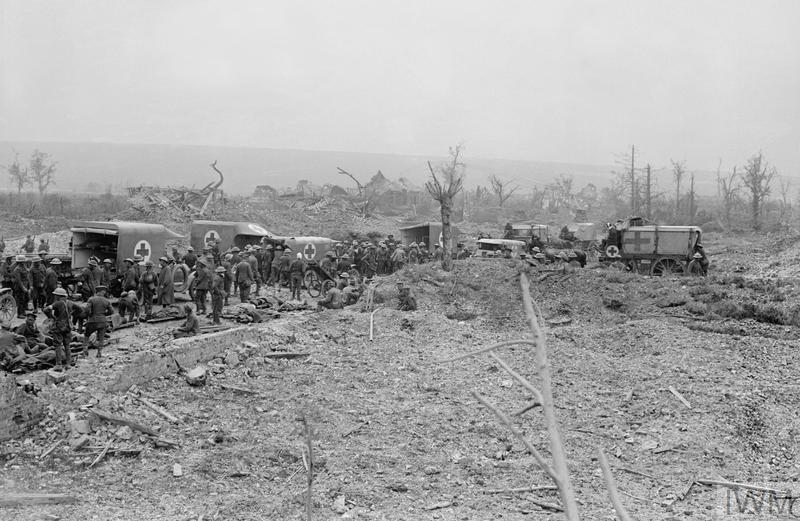 Motor ambulances and horse-drawn ambulance wagons of the RAMC collecting wounded on the Western Front © IWM (Q 9177)
The men were detailed as stretcher bearers, nursing orderlies, ambulance drivers, cooks, sanitation crew and to manage and distribute stores and water etc. The unit was divided into three equal sections, each of which could be self-sustainable, with its own tented areas, men and equipment.
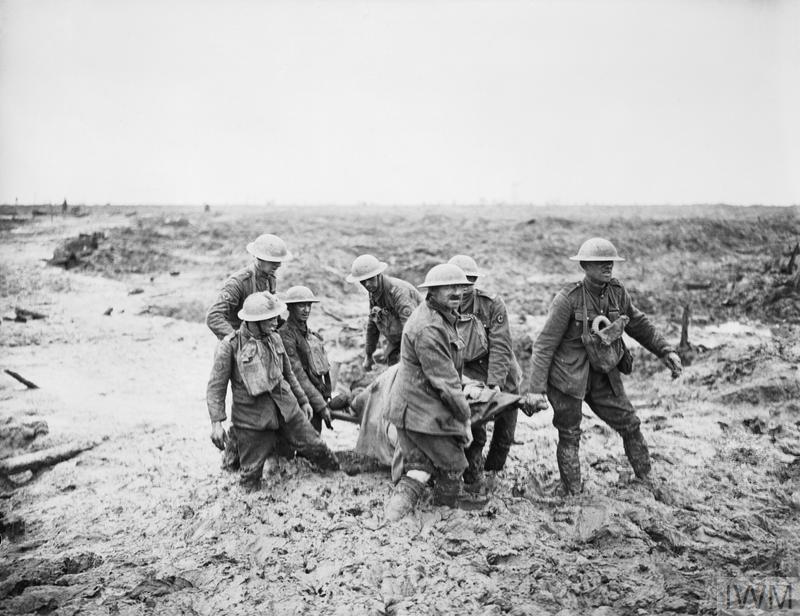 Stetcher Bearers in WW1 © IWM (Q 5935)
Each Field Ambulance had to be moved to where the combat was most intense and set up there.
Men of the Army Supply Company (ASC) were attached to assist with transport.
A Field Ambulance had 66 horses and 23 wagons. After the first year of the war transport included 7 motor vehicles and a maintenance wagon.
A full strength Field Ambulance unit in the First World War had a "capacity" for 150 casualties. In times of intense battle the unit would often treat a great many more.
RAMC officers and men were unarmed, they did not carry weapons (or ammunition). Over 6,873 RAMC personnel were either killed in action or died of wounds in WW1.
Through the work of the RAMC 1.6 million wounded men were returned to the firing line to fight again.
 RAMC personnel giving a wounded man water from a petrol tin in an abandoned trench. © IWM (Q 9177)
The 24th (1st Wessex) Field Ambulance and Teignmouth
The 24th was part of what is now called the Territorial Army. It was based in Exeter, Devon and trained part-timers in the same instruction manuals, exercises and drills as the regular RAMC.
In 1910, the unit opened a detachment at Teignmouth, a sea-side town about 14 miles from Exeter, Devon. The detachment slowly grew in numbers so that at the start of the First World War several Teignmouth men served in the ranks of 24th.
In September 1914, it was designated 1st Wessex Field Ambulance and joined the 8th Division, British Expeditionary Force, then sailed to France arriving at Le Havre on the 6th November 1914.
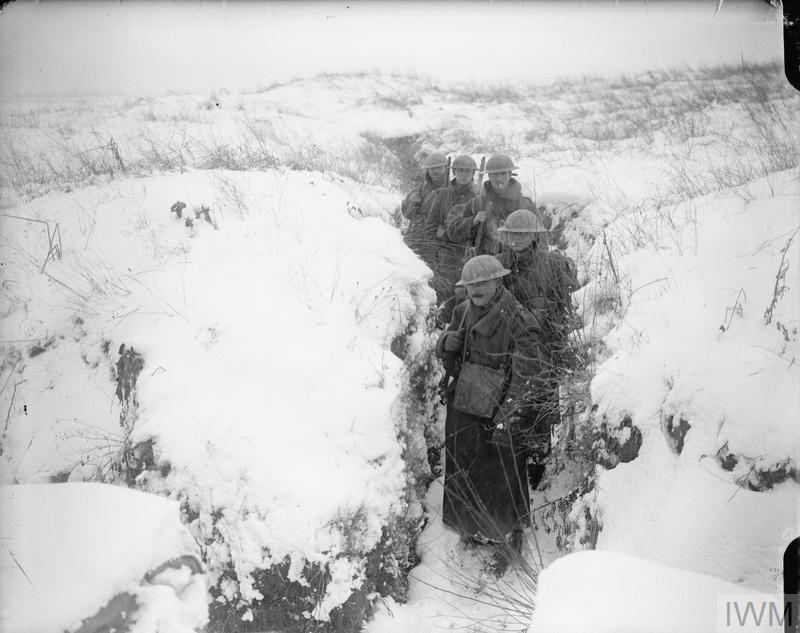 Troops coming out of a communication trench in the snow. © IWM (Q 4695)
On the 12th November the 24th arrived at the Front where they spent the winter focusing on diseases and the medical problems caused by the cold and wet conditions.
“Four inches of snow on the ground and snowing up to the 22nd (November) it was nearly impossible to sleep with only one blanket.
Barn we occupied last week blown up by shell fire. Had over nine hundred sick and wounded in a week.
The men having come straight from India &c (Cairo, Eygpt) went right into the trenches, owing to the shortage of troops, the snow and intense cold was playing havoc with them, and the bulk of the frost bite cases were quite helpless with swollen feet and had to be evacuated”.
War Diary of Albert House
Sergeant-Major of the 24th Field Ambulance
That is when the 1st Wessex Field Ambulance lost its first man.
Private James Pedrick of Teignmouth contracted meningitis whilst treating a patient and died in the hospital at St Omer on 17 February 1915.
On the 14th August 1916 Private William James Coombes of East Teignmouth and Private Samuel John Parker of Teignmouth and the 24th Field Ambulance died at an advanced dug-out dressing station, attending to the wounded, when a German shell hit the dug-out and exploded in the middle of it, killing and wounding about a dozen men.