Able Seaman Frank Pym
HMS Laurentic, Royal Navy
Died in Military Service
Date of Birth: 1891
Place of Birth: Battersea, London
Date of Death: 25 January 1917 aged 25
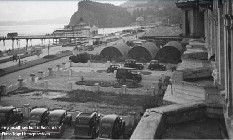
Buried: Remembered on Portsmouth Naval Memorial; Seafront Memorial and St. Michael’s Church, Teignmouth, Devon.
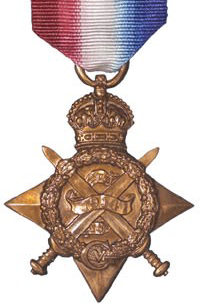
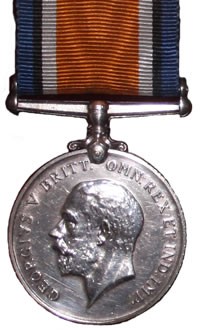
Awarded the 1914 Star, the British War Medal and the Victory Medal

Able Seaman Frank Pym aged 25.
Born at Battersea in 1891, he was the son of Captain Francis Pym, Topsham, who later lived at Perry Gardens, Poole. Frank visited Teignmouth frequently and stayed with his aunt, Mrs Carter.
He was a member of the Teignmouth Wesleyan Methodist School and was remembered on the Wesleyan Roll of heroes.
On 1911 census he was shown as a seaman on board SS Kiana in Fowey Harbour. In 1912/13 he was shown as a seaman on board the Iris registered at Poole.
At the beginning of the war Frank was one of the many men registered with the Royal Naval Reserve who were immediately called up to serve. Frank was one of the seaman who volunteered to join Churchill’s new service, the Royal Naval Division, and who fought on land during 1914. His father was later sent his 1914 star medal which was awarded to Frank for serving with the Anson Division, RND, service number 4655A. He had recently been on leave in Poole and Teignmouth and returned to his ship on 22 December 1916.
On 2 February 1917 the Teignmouth Post reported that “Mrs Carter of 10 Courtenay Place received intimation her nephew Frank Pym is not amongst survivors of HMS Laurentic”. It was later confirmed that Frank had not survived the sinking and was one of the men of the Anson Brigade, Royal Naval Division, who lost their lives on board this ship. He was reported as being killed by mine explosion off the north coast of Ireland on 25 January 1917. Remembered on Portsmouth Naval Memorial; Seafront Memorial and St. Michael’s Church, Teignmouth, Devon.
HMS Laurentic
SS Laurentic was a British ocean liner of the White Star Line. She was converted to an armed merchant cruiser at the onset of World War I.
The Laurentic arrived in Lough Swilly on the 25th January 1917 and the ship’s officers took the opportunity to go ashore and have a meal in the Lough Swilly Hotel, Buncrana.
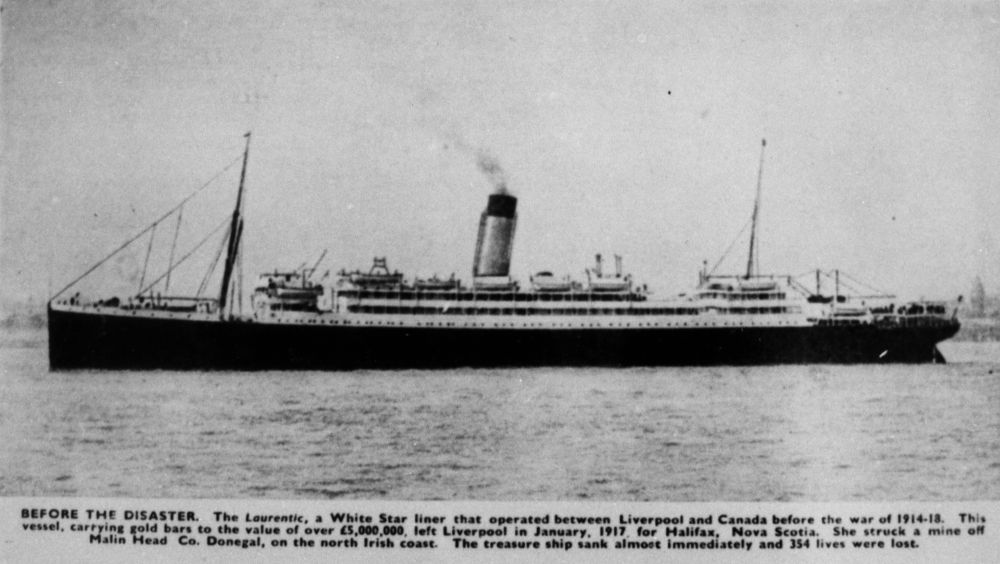 HMS Laurentic. John Oxley Library, State Library of Queensland Neg No 133078
However everyone was back on board before 5.00PM, when the ship finally left its berth and headed out into the North Atlantic, on a bitterly cold night, when a snowstorm was blasting the ship at gale-force 12.
As the Laurentic passed Fanad Head, approximately two miles off-shore, she struck her first mine, one of six, laid in a mine field earlier in the month by U-Boat U80, which had already returned to Germany.
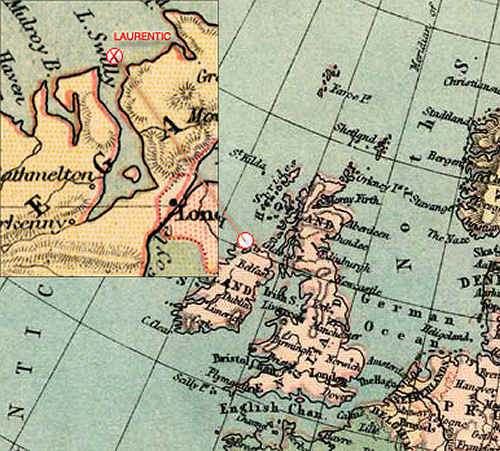 Map showing where HMS Laurentic sank
Then the Laurentic struck a second mine and began to settle quite quickly.
As the ship began to sink Captain Norton R.N. got the life boats out and got as many of the survivors into these as possible. Many of the initial survivors in the life boats died of exposure.
Meanwhile the second mine destroyed the engine-room and generators, killing most of the Engineering Officers and Engine Room Ratings. Because of this the ships pumps could not be deployed, and the crew had no power to get any radio warnings off.
After abandoning the stricken ship, those who managed to make it to the lifeboats rowed towards Fanad Lighthouse. Exposed to the extreme cold during the night as −13 °C (9 °F) many froze to death as they desperately tried to make it to shore and were found the next day with the oars still in their hands, some were rescued by local fishing trawlers.
A number of the deceased sailors were brought to the basements of The Lough Swilly Hotel, which was converted into an emergency morgue for the occasion. Of the 470 Officers and ratings on board, some 350 persons lost their lives. Of these a number of bodies were trapped on board and a larger number were washed out to sea. Corpses were washed ashore for many weeks after the sinking.
She had left Liverpool on 23rd January, 1917 bound for Halifax, Nova Scotia with a consignment of gold bullion to the value of £5,000,000 as payment for munitions. Over the years much of this gold has been recovered and the site is an official war grave.
The minefield had been laid by U.80 and HMS “Laurentic” struck two mines moored twenty feet below the surface and sank in 23 fathoms of water.