Nursing in Teignmouth and Shaldon
A War Plan drawn up in 1909/10 led to the Red Cross recruiting people to be trained in first aid and nursing.
 Audrey Lynne of Teignmouth instructed hundreds of people in First Aid through two world wars and the years in between.
The Red Cross files show the names and work details of the nurses who came from Teignmouth or Shaldon or Bishopsteignton. There are 43 women on the list and 2 others who came from London. Only 4 were married. Eleven were paid, but the rest were voluntary workers.
17 served in either Teignmouth or Newton Abbot hospitals.
10 served in other hospitals in Devon, 4 in London and 6 elsewhere in the UK. 8 served abroad, some in multiple locations.
Of the 45 women, 6 joined in 1914, 17 in 1915, 6 in 1916, 8 in 1917 and 7 in 1918.
Red Cross records pay rates for only 10 of these women.
24 are specifically recorded as having received no payment for all their hard work.
Teignmouth Hospital was placed at the disposal of the Red Cross (15 beds) as well as Bitton House.
The Teignmouth Post ran an advert stating 'the ladies could assist in nursing and with the needle'. The local Suffrage Society suspended their political agenda in order to help with the war effort. Appeals were made for "nurses with hospital experience, voluntary or paid; cooks, ward maids and any ladies who have a first aid certificate".
Red Cross working parties throughout the country organised the supply of clothing for soldiers in hospital. They also made vital hospital items such as bandages, splints, swabs and clothing.
 WW1 propaganda poster depicting a German nurse pouring a glass of water onto the ground in front of a wounded British soldier © IWM (Art.IWM PST 13544)
Dressings were not being commercially produced in large enough numbers at the time of World War I nor were there antibiotics for the treatment of infection. Every soldier carried two dressings in case of wounds.
To keep up with the huge demand for dressings, sheets were torn up. Later in the war, lace was used with appeals for textiles to make dressings.
When supplies of cotton wool ran out (being used as gun cotton as well), sphagnum moss was collected (particularly from Dartmoor where it was plentiful), dried and sewn into muslin bags to be used as dressing pads.
Tow (hemp based) was also used as an alternative absorbent material.
Dressings were usually sterilised when being used meaning finger infections were common among those dressing the wounded. Such infections in the absence of antibiotics sometimes lead to death. Used dressings were burnt to prevent the spread of infection.
By 1915, many women realised the war was not going to end soon and so volunteers from various countries from the Empire joined the medical and VAD services. Women found themselves working in different areas apart from the Western Front, including Russia, Serbia, Egypt and the Dardanelles.
Katherine Elizabeth Florence Williamson
At the age of Katherine 8 she was living in Marine Parade, Shaldon with her family (father a retired Army Lt Colonel).
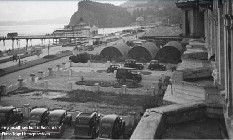
 Air raid damage done at the St John's Ambulance Brigade Hospital at Etaples in France, May 1918. © IWM (Q 290)
Katherine is recorded as having a medal from the Order of St John (WO372/23/45265).
She became a VAD nurse and served as a Nursing Sister in the Newton Abbot VA Hospital from May 1915 to November 1917 and also at the St John's Hospital in Etaples, France from March to June 1918.
Remembering the work of Marie Curie
Maria Salomea Sklodowska was born in Warsaw on 7 November 1867. She married Pierre Curie, professor of the School of Physics, Paris and they worked together investigating radioactivity. Pierre was killed by a carriage in 1906.
 Marie Curie (Image Public Domain)
Marie Curies' research was crucial in the development of x-rays in surgery. She realised that X-rays could save soldiers' lives by helping doctors see bullets, shrapnel, and broken bones and therefore improve the outcome of surgery.
She campaigned for the setting up of France's first military radiology centres.
She raised money and sought donations of vehicles for mobile units that could be used at the front. She convinced automobile body shops to transform these vehicles into vans, and begged manufacturers to do their part for their country by donating equipment.
By late October 1914, the first of 20 radiology vehicles she would equip was ready and she held training courses for medical orderlies and doctors in the new techniques.
French soldiers nicknamed these mobile radiology units 'petites Curies' (little Curies).
 Marie Curie Radiology Van, nick-named 'Petites Curies' (Little Curies).
Intending to operate the equipment herself if necessary, Marie learned how to drive a car, studied anatomy and basic motor vehicle maintenance in preparation.
To assist her Marie took along her 17-year old daughter Irène. Accompanied by a military doctor, mother and daughter made their first trip to the battle front in the autumn of 1914.