Private Charles Meville Hewlett
Royal Army Medical Corps (RAMC)
Died of tuberculosis
Date of Birth: 4 June 1893
Place of Birth: Sheffield, Yorkshire
Date of Death: 26 March 1918 in hospital
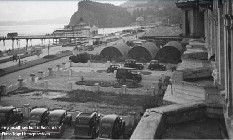
Buried: Teignmouth Cemetery; remembered on Seafront Memorial and St. James’ Church Memorial Window, Teignmouth, Devon.
Awarded the British War Medal and the Victory Medal
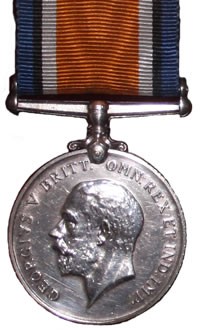

Private Charles Melville Hewlett age 24.
Charles was born in Sheffield on 4 June 1893 and baptised on 3 August, the son of John, a cleric, and Emma Hewlett; they were living at Fulwood Vicarage, Yorkshire. He was still living here with his family in 1901. His parents later moved to Australia. His army record shows his previous occupation as a fruit farmer.
Charles attested at Exeter on 6 September 1915 and served in France from 27 May 1916 to 22 November 1917 with the Wessex Regiment, Royal Army Medical Corps, service number 463063. He was admitted to Exeter Military Hospital with tuberculosis of the lung on 23 November 1917, and subsequently discharged medically unfit on 24 December 1917. Awarded a silver war badge on 1 January 1918, he was discharged into the care of his sister Mary, a nurse, who lived at West Brimley House, Teignmouth. Charles died in the Military Hospital, Exeter, on 26 March 1918.
Buried on 30 March in Teignmouth Cemetery; remembered on Seafront Memorial and St. James’ Church Memorial Window, Teignmouth, Devon.
“The many friends of the Rev J. H. Hewlett, M.A., and Mrs Hewlett will regret to hear of the death of their younger son, Charles Melville Hewlett, who, after 20 months hard work in the R.A.M.C., succumbed to meningitis at his sister's nursing home in South Devon on 26th March. The deceased soldier, who previously resided with his parents at Bamawm, Australia, was much esteemed, and not once in all his many letters was a syllable of complaint. He did his duty nobly, and laid down his life for King and country, and in our righteous cause. The members of St Paul's Church, Bendlgo, to whom the parents endeared them' selves during the Rev J. H. Hewlett's ministry in the parish, express their sympathy with the sorrowing family. The, Rev J. H. Hewlett, who is staying with Mrs Hewlett at Kyneton, is acting rector at St Paul's Church, Kyneton, for a few weeks.” Rochester Express, Australia, - 9 April 1918
“Hewlett death announced at West Brimley House on 26March, tubercular meningitis contracted in France” Teignmouth Post - 29 March
Different records show him listed as Charles Montague Hewlett or Charles Meville Hewlett.
A Royal Army Medical Corps Field Ambulance
A Field Ambulance was not a single vehicle, but an entire mobile hospital that served in the combat zone.
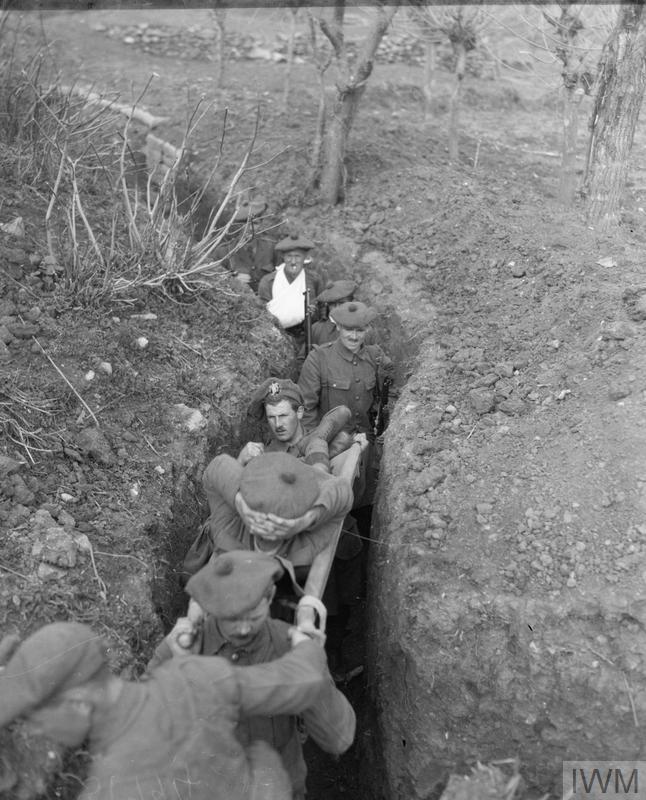 Casualties from a Scottish infantry battalion of 77th Brigade being evacuated along a communication trench outside Salonika, February 1916.© IWM (Q 31794)In the First World War, at the Front Line in battle there were often vast numbers of casualties requiring immediate treatment.
The Royal Army Medical Corps (RAMC) operated a system that immediately addressed a patient's critical injuries near the Front, then evacuated him to a medical unit in a safer area.
To achieve this goal the RAMC had units consisting of 10 officers and 224 men. The entire company was called a Field Ambulance.
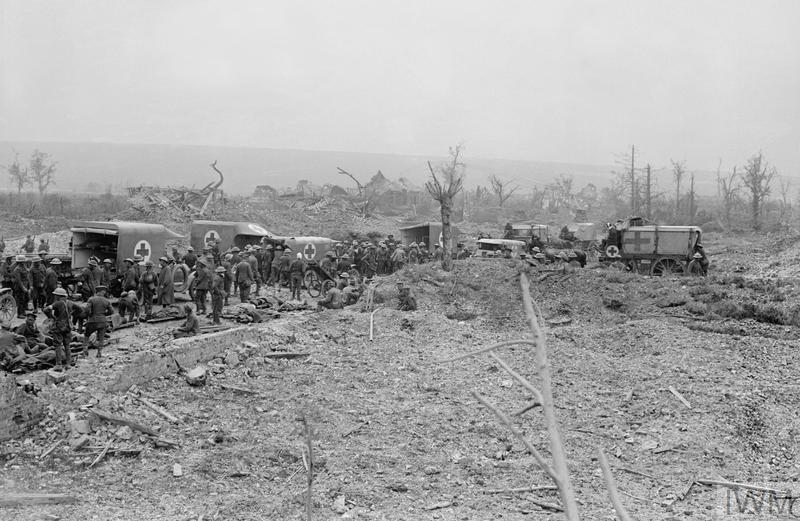 Motor ambulances and horse-drawn ambulance wagons of the RAMC collecting wounded on the Western Front © IWM (Q 9177)
The men were detailed as stretcher bearers, nursing orderlies, ambulance drivers, cooks, sanitation crew and to manage and distribute stores and water etc. The unit was divided into three equal sections, each of which could be self-sustainable, with its own tented areas, men and equipment.
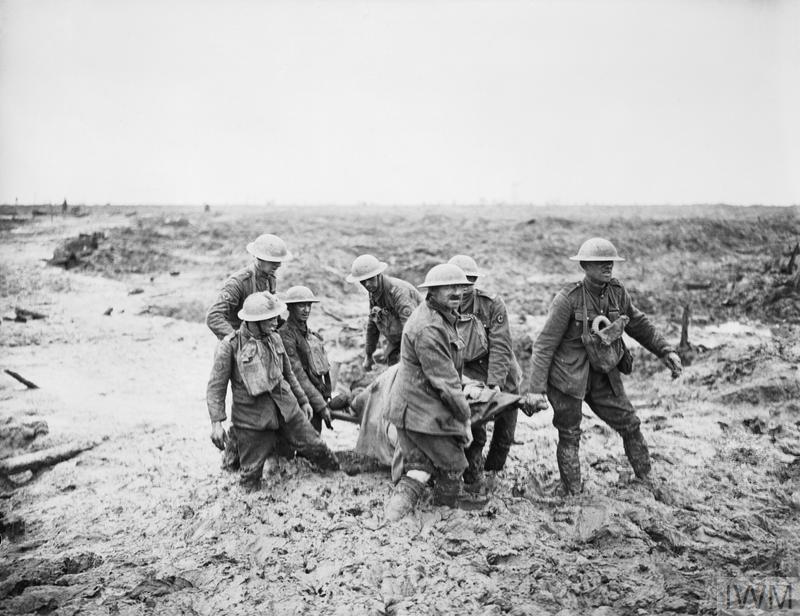 Stetcher Bearers in WW1 © IWM (Q 5935)
Each Field Ambulance had to be moved to where the combat was most intense and set up there.
Men of the Army Supply Company (ASC) were attached to assist with transport.
A Field Ambulance had 66 horses and 23 wagons. After the first year of the war transport included 7 motor vehicles and a maintenance wagon.
A full strength Field Ambulance unit in the First World War had a "capacity" for 150 casualties. In times of intense battle the unit would often treat a great many more.
RAMC officers and men were unarmed, they did not carry weapons (or ammunition). Over 6,873 RAMC personnel were either killed in action or died of wounds in WW1.
Through the work of the RAMC 1.6 million wounded men were returned to the firing line to fight again.
 RAMC personnel giving a wounded man water from a petrol tin in an abandoned trench. © IWM (Q 9177)