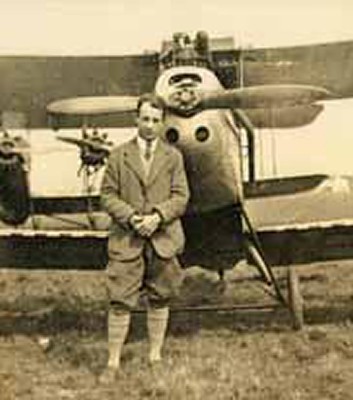
Flying Officer Mechanic William Richard Parkhouse
Royal Navy Air Service, 208692
Date of Birth: 15th of August 1891
Place of Birth: Chulmleigh, Devon
Date of Death: 29th of May 1969
Buried: Exeter, Devon
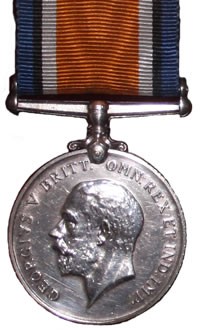

Awarded the British War Medal and the Victory Medal
In 1901, the Parkhouse family were living at Fore Street, Chulmleigh, South Molton, Devon. William Parkhouse, father and head, born 1859, a Provision Dealer & Farmer and Julia Parkhouse, the mother, born 1858, a Stationer Shopkeeper. Brother John H H Parkhouse, born 1886 and sister Gwendolen E M Parkhouse, born 1896.
In the 1911 census, William is a boarder at 9, Crescent Gardens Bath, Somerset. He is an Engineers Apprentice.
William attested for the Royal Navy Air Service on the 7th of October 1915. He served on several ships including HMS Ark Royal which was the first ship designed and built as a seaplane carrier. William was an engineer.
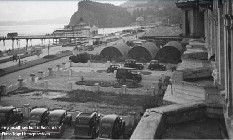
![Ark Royal WW1 - By Official Royal Navy photographer - This is photograph [http://www.iwm.org.uk/collections/item/object/205185993 A12031] from the collections of the Imperial War Museums (collection no. 4700-01), Public Domain, https://commons.wikimedia.org/w/index.php?curid=17186331](/images/survived/parkhouse-wr-ark-royal-ww1.jpg) Ark Royal WW1 - By Official Royal Navy photographer - This is photograph [http://www.iwm.org.uk/collections/item/object/205185993 A12031] from the collections of the Imperial War Museums (collection no. 4700-01), Public Domain, https://commons.wikimedia.org/w/index.php?curid=17186331
Ark Royal WW1 - By Official Royal Navy photographer - This is photograph [http://www.iwm.org.uk/collections/item/object/205185993 A12031] from the collections of the Imperial War Museums (collection no. 4700-01), Public Domain, https://commons.wikimedia.org/w/index.php?curid=17186331
Haldon Aerodrome
The proprietor of Haldon Aerodrome (Teignmouth, Devon) School of Flying.
Entered the R.N.A.S. in 1915 and was an instructor at Yatesbury in 1918. He served in the R.A.F. until 1919 and then established Haldon Aerodrome in 1928. He was a member of the Guild of Air Pilots and joined the R.A.F. Reserve in 1923.
 Haldon Aerodrome
Haldon Aerodrome was the first airfield in Devon. Established in the 1920s as a private flying field, it developed into an airport with scheduled airline service and was used by the Navy during WW2.
 Haldon Aerodrome
The airport has also been known as Teignmouth Airport, Little Haldon Airfield and, in its military days, RNAS Haldon and HMS Heron II.
William Richard or Bill Parkhouse, an ex-Royal Naval Air Service (RNAS) pilot, established the Agra Engineering Company as a motor company in Teignmouth after WW1. He had hoped to expand by becoming the West Country dealer for De Havilland aircraft and wanted a flying field for himself.
William married Alice Vera Clarke in the 3rd quarter of 1925.
In 1928 he rented 80 acres of heathland to the north-west of Teignmouth. There are not many flat areas in the region, and despite the rough ground and the altitude of the field leading to regular high winds and low cloud, he established an airfield.
The land was rolled as flat as possible with a concrete roller pulled by an ancient tractor, and boundaries were marked with some white-painted rocks.
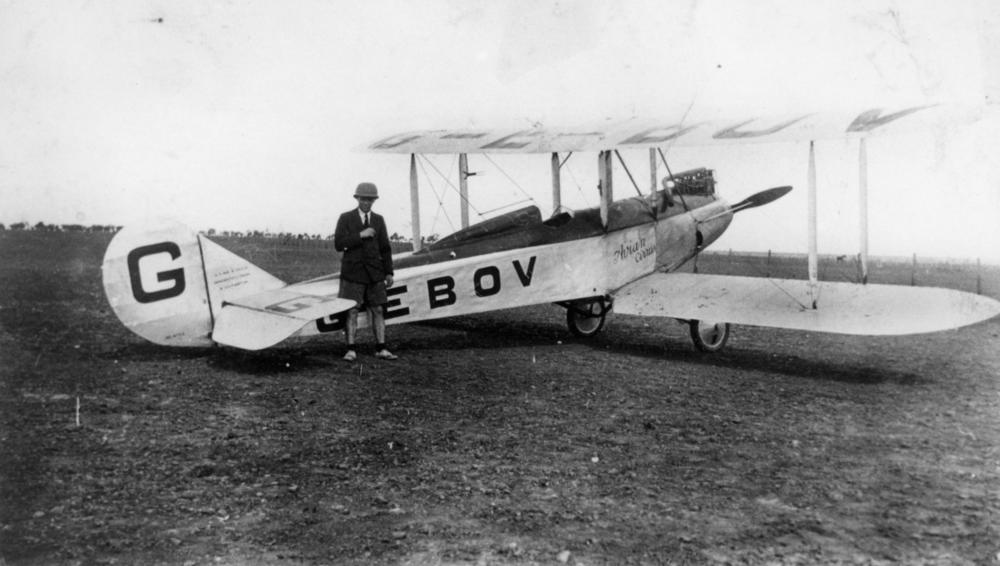 Avro Avian IIIBy this time the local De Havilland dealership had been awarded to another company, and Willam gained a concession from the Avro company buying an Avro Avian III, G-EBXO. This was the first aircraft to land on the new airfield. William flew it in on the 6th of May 1928. As there was no hangar on the airfield he folded the wings and towed the aircraft into town, placing it in his car showroom.
A small corrugated iron hangar was built, capable of holding two light aircraft, and a fuel tank and pump installed. A landing circle was marked out and also the name Haldon in 16 feet high letters.
William started giving flying lessons, and one of his first pupils was Whitney Straight, a member of the prominent Whitney Whitney Straight - By Unknown author - Tvedte, Jon: Flyvningen. Det moderne eventyr, Oslo, 1958, Public Domain, https://commons.wikimedia.org/w/index.php?curid=16562517 family of the United States, who lived at nearby Dartington Hall, who offset some of the cost of the lessons by driving the tractor to help level the field.
With William Parkhouse's tuition, Straight gained his "A" licence a few days after his 17th birthday with 50 hours in his logbook. By the end of 1928, the airfield was quite busy, with 13 student pilots.
In the 1929 electoral register, William and Alice are living at 5, Bank Street, Teignmouth, Devon.
The De Havilland dealership in Teignmouth had not gone well, having not sold any aircraft at all, so in 1929, William Parkhouse succeeded in taking it over.
 De Havilland Gipsy MothHe bought one himself, selling the Avian to Whitney Straight, who subsequently bought two more De Havillands, a Gipsy Moth and a Puss Moth, from William Parkhouse's agency.
William also sold aircraft to his friends, and others and several of them provided him with good business by often upgrading to the latest models. Several also based their aircraft on the airfield. He was proud to boast that his garage was the only garage in the country that also sold aeroplanes.
 Howard Pixton - By Burroughs Wellcome and Company - https://www.flickr.com/photos/internetarchivebookimages/14782499695/, No restrictions, https://commons.wikimedia.org/w/index.php?curid=87396836William's ground engineer around 1929 was Howard Pixton who had been A V Roe's first test pilot before winning the 1914 Schneider Trophy races at Monaco. He had recently come from Windermere in the Lake District where he had run a small floatplane operation for Avro.
The official opening of the airport took place on the 21st of September 1929, which Sir Sefton Brancker, the Director of Civil Aviation attended, arriving in his Moth appropriately registered G-EDCA. A flying display was held, but a planned air race was abandoned due to poor weather conditions.
The South Devon Flying Club was formed here in 1933, and the airfield became popular with horse jockeys and trainers visiting local racecourses at Exeter, Newton Abbot and Totnes.
On the 1st of January 1937, Whitney Straight's Straight Corporation formed Haldon Airport Ltd which took over the management of the airport from William Parkhouse, and the following year it bought the freehold of the land.
William Parkhouse was at that time involved with establishing airports at Plymouth and Exeter, both of which projects the Straight Corporation took over, and William Parkhouse went on to be the director of Exeter Airport Ltd, and also a member of the board of Airways Union, the Straight Corporation's holding company.
The flying club at Haldon became a branch of the Plymouth and District Aero Club, also run by the Straight Corporation.
In the summer of 1937, the Devon Gliding Club started, and Whitney Straight was an active member.
 William Richard Parkhouse - Teign Heritage Archives
At the end of 1938, the government's Civil Air Guard subsidised pilot training scheme was started, and 19 applications were received for training at the flying club.
Scheduled services
GWR Air Services set up the first scheduled service at Haldon. It started on on the 12th of April 1933 as a stop on their twice-daily Cardiff — Plymouth service. It used Westland Wessex airliners leased from Imperial Airways, and a suitably timed bus service-connected their passengers with Teignmouth and Torquay. The service only lasted until the end of the year, when the airline was merged into the new Railway Air Services.
Provincial Airways ran a West Country Air Service between Croydon Airport and Plymouth, with intermediate stops at Southampton and Haldon, which they called Torquay. Starting in November 1933 they used De Havilland Fox Moths, which in May 1934 were replaced by De Havilland Dragons. During 1935 the service ran twice daily but ended when the airline closed at the end of the year.
Railway Air Service
Railway Air Services started service on the 7th of May 1934 linking Liverpool with Plymouth via Birmingham, Cardiff and Haldon (which they often called Teignmouth). They promoted links with Western Airways for connecting flights to Bristol and Bournemouth.
Air Dispatch Ltd during 1934 operated a service from their base in Croydon via Portsmouth and Haldon to Plymouth. The company was founded in 1934, one of several airlines founded by the Hon. Mrs Victor Bruce.
Scheduled services moved to Exeter when that airport opened on 31 May 1937.
WW2
On the 3rd of September 1939, all civilian flying in the UK was prohibited. The airfield lay unused for a while, before being requisitioned by the Air Ministry and occasionally used by communications aircraft during armament testing at a nearby range.
The Research Development Flight used the airfield to help develop balloon cable cutters and airfield rocket defences.
It  HMS Heronwas then transferred to the Admiralty as RNAS Haldon, and as an outpost of RNAS Yeovilton (HMS Heron), was named HMS Heron II on the 18th of August 1941. It was used by the Fleet Air Arm for target towing by detachments of Blackburn Skuas of 794 Squadron and Miles Masters of 761 Squadron.
No 84 Gliding School of the Air Training Corps also moved in, leaving for Exeter in June 1946.
Being too small for larger aircraft, more land was requisitioned, some from a neighbouring golf course, and the runways were extended. A few hardstandings were also built, and some Sommerfield steel track was laid and land drainage work was undertaken, enabling larger aircraft such as Boulton Paul Defiants and Miles Martinets to use the airfield. Nearby accommodation was also requisitioned.
In January 1943, HMS Heron II moved to RNAS Charlton Horethorne which had opened on the 10th of July 1942, and by May 1943 the admiralty had grown tired of the high winds and low cloud that so often hampered operations, and the airfield was reduced to a Care and Maintenance status. There was very little activity at the airfield for the remainder of the war.
William was living at Grove Corner, Grove Hill, Topsham, Exeter at the time of his death.