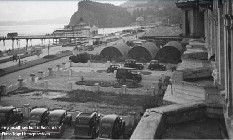
Lieutenant-Colonel Henry Alexander Schank OBE
3rd Battalion, Lancashire Fusiliers
Date of Birth: 3rd quarter of 1856
Place of Birth: Teignmouth, Devon
Date of Death: 4th quarter of 1919
Buried: Teignmouth Old Cemetery, plot MM180
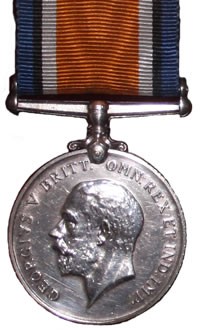
Awarded an OBE, the Queen's South Africa Medal (1901, 1902 clasps), the British War Medal and the Victory Medal

Henry Alexander Schank was born in the 3rd quarter of 1856 and baptized on the 10th of September 1856, Anglican, at East Teignmouth. His Father's name was John Mackellar Skeene Grieve Schank, 1809, a Solicitor, and his Mother's name, Mary, 1823.
| Henry Alexander Schank 1857 | Margaret Eleza Helen Schank 1858 |
| Louisa Schank 1861 | Ellen Agnes Schank 1864 |
The Schank family were living at the Strand, East Teignmouth in the 1861 census. John Mackellar Skeene Grieve Schank profession was "Solicitor & Notary". Ann Parish, the mother-in-Law, 1789, was living with them and they employed one live-in servant.
On the 11th of January 1886, Henry Alexander Schank married Ada Cheveley Deshon, 1859, at East Teignmouth.
In 1891, Henry and Ada were living at Lower Brimley Villas, East Brook, West Teignmouth. Henry's sister, Margaret E H Schank, was living with them and "Living On Her Own Means".
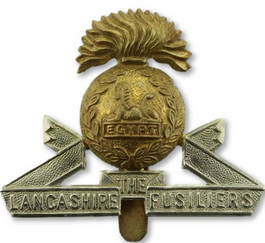 Lancashire Fusiliers cap badge
1899-1902 – Henry Alexander Schank, was a Captain during the Ango-Boer wars, in the 5th Regiment of the Lancashire Fusiliers.
Ada Cheveley Schank died on the 12th of February 1907, registered at Reading, Berkshire. Henry was the Primary Beneficiary of Ada’s will.
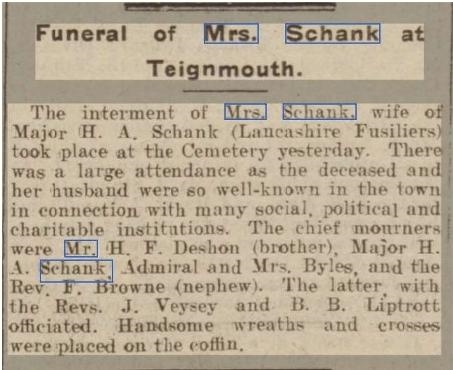 Western Times 16 February 1907 - Funeral of Ada Cheveley Schank
In 1911, Henry was living at 4, Grove Crescent, Teignmouth. Henry's profession was "Lieutenant Colonel Commanding 3rd Lancashire Fusiliers".
In the 2nd quarter of 1911, Henry married Margaretta Maitland Coleman at Kensington, London.
During World War 1, Henry was appointed as a General Staff Officer.
General Staff Officers are a group of officers, enlisted and civilian personnel that are responsible for the administrative, operational and logistical needs of its unit. It provides a bi-directional flow of information between a commanding officer and subordinate military units.
In the King George V 1919 Birthday Honours, Henry was honoured 'In recognition of services in connection with the War' by the award of Officer of the Order of the British Empire (OBE).
Movement of the Lancashire Fusiliers during WW1
1914
- Mobilisation - 04/08/1914
- Move To Egypt - 10/09/1914
1915
- Defence Of The Suez Canal - 03/02/1915
- The Battles Of Helles - Second Battle Of Krithia - 06/05/1915
- Second Battle Of Krithia - 06/05/1915
- Second Battle Of Krithia - 06/05/1915
- Disbandment - 09/05/1915
- Third Battle Of Krithia - 04/06/1915
- Krithia Vineyard - 06/08/1915
- Move To Egypt - 27/12/1915
1916
- Battle Of Romani - 04/08/1916
1917
- Move To France - 22/02/1917
- Operations On The Flanders Coast - 24/09/1917
1918
- First Battles Of The Somme - Battle Of Bapaume - 24/03/1918
- First Battles Of The Somme - First Battle Of Arras - 28/03/1918
- First Battles Of The Somme - Battle Of The Ancre - 05/04/1918
- Second Battles Of The Somme - Battle Of Albert - 21/08/1918
- Second Battles Of The Somme - Second Battle Of Bapaume - 31/08/1918
- Battles Of The Hindenburg Line - Battle Of The Canal Du Nord - 27/09/1918
- Battles Of The Hindenburg Line - Pursuit To The Selle - 09/10/1918
- The Final Advance In Picardy - Battle Of The Selle - 17/10/1918
Location: Marou. Allied victory. Following the Allied breakthrough of the Hindenburg Line, German forces retreated across the natural defence line of the River Selle to hastily-prepared, but well-defended positions.
On Thursday 17th October, Fourth Army attacked along a ten-mile front to the south of Le Cateau; despite a creeping barrage and under cover of a heavy mist, the British advance met determined enemy resistance. Alerted to a forthcoming attack by the increase in British activity, the Germans had reinforced their positions where a river crossing was most likely.
To the right, the attack met the least resistance and advanced to take Le Cateau by the end of the day. Over the following two days the main attack force of First and Third Armies, assisted by the arrival of the French troops originally promised for 17th October, forced the enemy back towards the Sambre-Oise Canal.
 Horse-drawn British transport © IWM (Q 80084)
A night attack by Third and First Armies took high ground to the east of the River Selle and having allowed time for the supporting heavy artillery to catch up, all three British Armies were able to continue their advance, taking nearly 20,000 prisoners of war in one week.
When Third Army began its attack on 20th October, 42nd (East Lancashire) Division moved out from the bridgehead they had established at Briastre to attack the objectives assigned to IV Corps.
The advance was to be carried out in three phases, 126th Infantry Brigade leading the first phase to capture the railway cutting from Solesmes, then 127th Infantry Brigade moving through to advance on to Marou and finally 125th Infantry Brigade pushing beyond Marou.
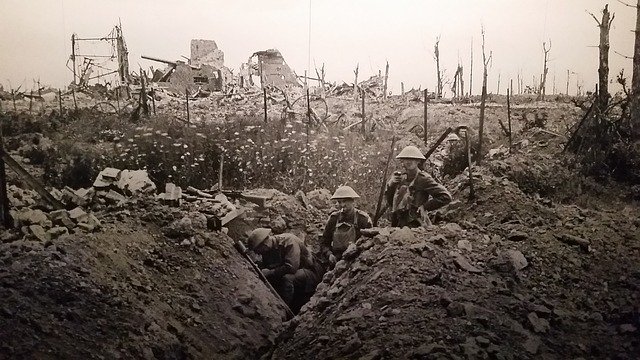 Trench warfare Image by Bruce Mewett from Pixabay
The advance encountered stiff resistance along the whole route, that meeting the 5th Manchester Regiment on the right being particularly severe. Marou was captured by mid-afternoon and a and after a counter-attack broken-up by the artillery, the advance continued to the outskirts of Romeries, a gain of around 2 miles.
A further assault on 23rd October pushed the advance to the outskirts of the Foret de Mormal (Forest of Mormal) where they were relieved by the New Zealand Division. Withdrawn into IV Corps Reserve, the Division halted around Beauvois until 3rd November when the advance was resumed.
On 10th November the Division captured Hautmont and Fort Hautmont and at 11.00 am on 11th November, when the Armistice came into effect, 42nd Division was halted around Hautmont, with its most advanced troops on the Maubeuge to Avesnes road.
Henry Alexander Schank died in the 4th quarter of 1919 aged 63.
 Western Times 21 October 1919 - Death of Lieutenant Colonel Henery Alexander Schank of Teignmouth
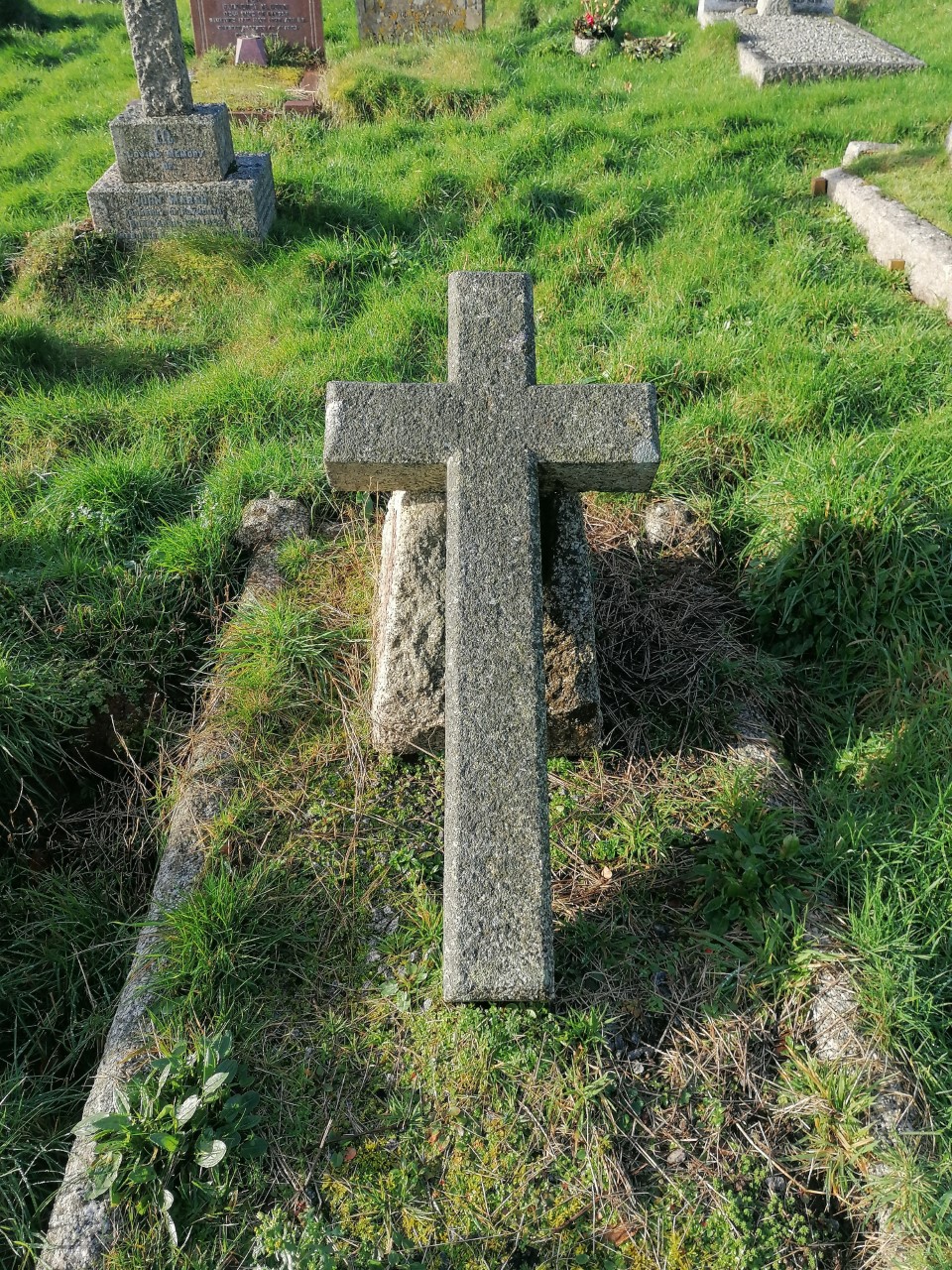 Henry Alexander Schank and Margaretta Maitland Schank grave