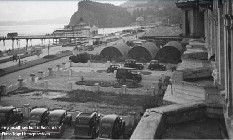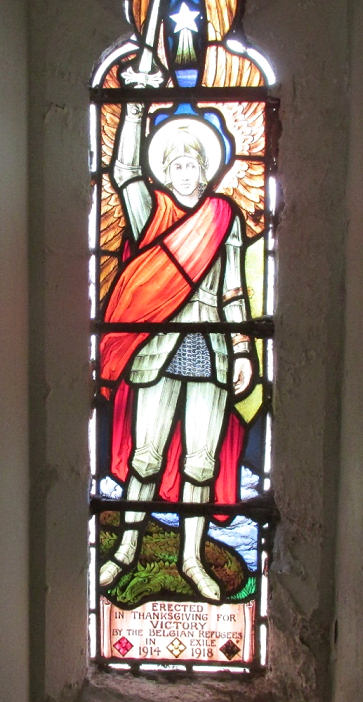
During late 1914 and early 1915 Belgian refugees were housed in Teignmouth and Shaldon. Names of some of refugees who lived, were born, married or died in Teignmouth or Shaldon can be found in local records.
On the eve of World War 1, as German forces demanded safe passage through Belgium on their way to attack France, the Belgian King refused to stand aside.
What followed has become known as 'the rape of Belgium' and the popular image of 'the Hun' rampaging through 'gallant little Belgium' contributed to popular support for the war, particularly among a British population in fear of invasion.
View more
An estimated 1.5m. refugees fled Belgium ahead of invading German forces in September 1914.
 Fugitives from Antwerp following the occupation of the city on 10 October by German forces.© IWM (HU 52449)
View more
"hundreds of thousands of refugees, their goods on barrows and hand-carts and perambulators and wagons, moving with infinite slowness out into the night, two unending lines of them, the old men mostly weeping, the women with hard drawn faces, the children playing or crying or sleeping.
That's what Belgium is now: the country where three civilians have been killed for every one soldier… It's queer to think one has been a witness of one of the greatest crimes of history. Has ever a nation been treated like that? And how can such a stain be wiped out?"
Rupert Brooke, Poet describing the scene in a letter home
(He saw action near Antwerp)
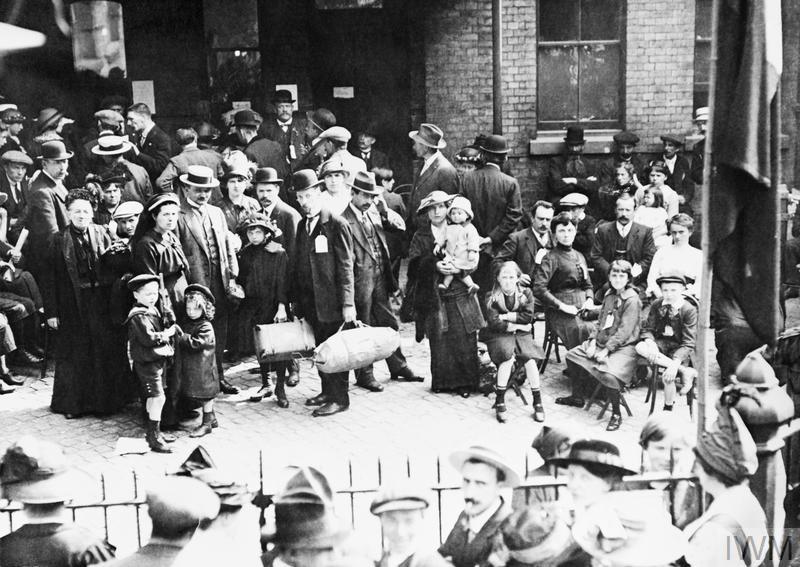 Families of Belgian refugees Victoria Station, London, September 1914. © IWM (Q 53305)
For many including residents of Teignmouth and Shaldon, helping some of the estimated 160,000 of the refugees finding shelter in Britain, was their way of contributing to the wider war effort.
The first Belgians reached the southern ports of England in late August 1914.
Initially in small numbers and mostly at their own expense, they moved inland and settled usually in and around London.
" The same day two Liverpool's are billeted at our inn the first refugees arrive. They came by boat, women and children mostly. A few old men. From Belgium. They dock at the harbour and Dr.Collings aboard, but rumour has it that he's soon on dry land again.
It was a bad crossing, that was for certain, and every man, woman and child is green as the sea, and the deck strewn with their suffering. But by the time I see them they're washed and clean and sitting around a long table at the Constitutional Hall where mother helps to serve them lunch of bread and ham. I'm there to help too.
Bring in the plates and cups and fill the kettle with water, but really I've come along to gawp. I've never seen a foreigner before. Only Mac and the herring girls, who hard as they are to understand, are ruled by the same King. The Belgians as much as I stare at them, don't seem different to us. The women are bare-headed that's true, ours never go out without a hat, but their hair is tied back and twisted right into a bun just like the ladies in the Constitutional Hall now that they're safely inside.
It's not just me who's watching them all around the hall there are men and women standing staring, and under their gaze the Belgian mothers do their best to shush the children sitting on their knees and keep the older ones from choking on their food, so hungrily do they shove it in. The men broken with nothing to distract them, look the most likely to give in and weep."
Mr. Mac and Me
Novel by Esther Freud