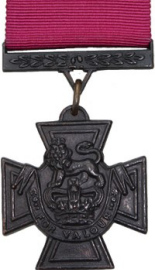
 Victoria Cross
Victoria Cross (V.C.)
(Level 1 Gallantry Award)
Instituted on 29th January 1856
The highest award for gallantry. All ranks are, eligible when serving with the British and Commonwealth armed forces.The Royal Warrant for the award of the Victoria Cross has essentially remained the same since the inception of the medal to the present day. It was, and still is, awarded "for most conspicuous bravery, or some daring or pre-eminent act of valour or self-sacrifice, or extreme devotion to duty in the presence of the enemy."
The Victoria Cross can also be awarded to civilians if they were under military command at the time of the act of bravery.
The George Cross (G.C.) is an equivalent award but is made to an individual, military or civilian, who has carried out an act of special courage when not in the face of the enemy.
Queen Victoria was very interested in the medal, especially as it was to be named after her. She preferred the name of "Victoria Cross" to the suggested title of "The Military Order of Victoria" and involved herself in the design, suggesting the words "For Valour" as the inscription instead of the suggested words "For the Brave".
The original copper cross design was rejected in favour of a medal made from the cascabels (the knob and the neck of a breech-loading cannon) of two Russian (albeit of Chinese origin) cannons captured in the Crimea. There is approximately 10kg of remaining metal from The original cannon is stored in a secure vault and only taken out under an armed guard. The jeweller, Hancocks of London, has been responsible for casting the Victoria Cross medal from the first one to the present day.
Until April 1918 the medal ribbon issued with the Victoria Cross medal was red (or crimson) for Army recipients and blue for Navy recipients. When the Royal Air Force was formed on 1st April 1918 it was decided that recipients from all of the three Services should wear the crimson ribbon with the medal. Those Naval personnel that had received a blue ribbon previously were also to wear the crimson ribbon from then on.
There were 615 Victoria Crosses awarded during the First World War, 415 to the British Army, 51 to the Navy and Marines, 9 to the Royal Flying Corps and Royal Air Force and 140 to the Dominion Forces.